
I still remember the first time I stared at a fully upgraded 5-Star Echo and realized I had poured a week of Tuners into a stat spread that belonged in a museum of bad decisions. Since then, I have learned that Echoes in Wuthering Waves act less like ordinary armor pieces and more like mineral veins you hammer open blind: the Sonata Effect is the rock face, but the inner stat veins decide whether you walk away with gold or gravel.
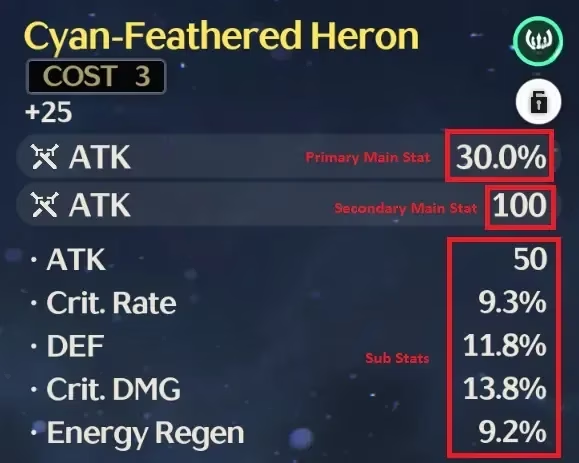
Echoes range from 1-Star to 5-Star, with max upgrade levels stretching from +5 to +25. From 3-Star Echoes onward, every five levels add a Tuning Slot and a possible Sub Stat. Rarity is not just a label; it changes how high the main stat and sub stat rolls can climb. A 4-Star Echo at +20 gives you four Tuning Slots, while a 5-Star Echo at +25 gives five. I treat the upgrade screen like an apothecary cabinet of locked drawers: each five-level interval opens another drawer, but you never know if the contents are healing herbs or dried beetles.
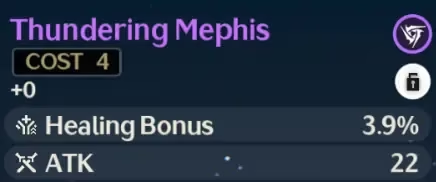
This is why most players, myself included, refuse to level Echoes unless they are 5-Star and carry the main stat we actually want. Echo XP materials and Tuners are too scarce to spend on placeholders. When you feed a previously leveled Echo into another, you only recover about 70% of the experience and Tuners invested. That loss is tolerable when correcting a mistake, but it becomes a silent tax if you treat every shiny Echo as a project.
Each Echo has two main stats: the primary main stat is random, while the second is predetermined. The primary stat pool changes depending on Echo Cost. Echoes are separated into three Costs based on enemy type, and base values increase with rarity. In practice, I look at the 4-Cost Echo for high-impact personal stats, the 3-Cost Echoes for elemental or utility scaling, and the 1-Cost Echoes for small but meaningful foundation stats.
The trickiest part of primary stats is the Elemental DMG Bonus on 3-Cost Echoes. Any element can roll into an unrelated element set, so an Aero DMG Bonus can appear on a Glacio set Echo like a snowflake landing in a desert. This is why rewards such as Malleable Elite Class Echo I and Malleable Elite Class Echo II are precious: they let you target both the correct Sonata set and the matching elemental DMG. Use them as if they were rare surgical tools, not everyday farming drops.
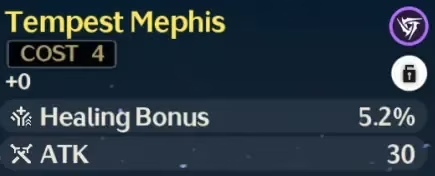
For general farming, DPS characters usually prefer Crit. Rate on the 4-Cost Echo, Elemental DMG % or ATK % on the 3-Cost Echo, and ATK %, HP %, or DEF % on the 1-Cost Echo depending on the character's scaling. Some characters do not scale with ATK at all, so read the kit before you pour resources into a stat that does nothing. Certain characters want Energy Recharge on 3-Cost Echoes to keep their ultimate reliably charged. Healers often want Healing Bonus on the 4-Cost Echo.
Sub Stats unlock every five levels by spending Tuners equal to the Echo's rarity. A 4-Star Echo at +20 has four Tuning Slots; a 5-Star at +25 has five. Sub Stats are chosen from a fixed value range regardless of Echo rarity, which means a low-rarity Echo cannot somehow roll a stronger sub stat than a 5-Star. You can roll both flat and percentage versions of the same stat, and you can even duplicate a main stat as a sub stat, such as double Crit. Rate %. That duplication is where top-tier builds are made, but it also turns stat rolling into a balancing act on a razor's edge: one missed Tuning Slot can turn a promising Echo into fodder.
Most characters follow the same sub stat principles as their main stats. DPS characters really want Crit. Rate %, Crit. DMG %, and ATK %, while DMG % rolls are decent fallbacks. Everyone wants a certain amount of Energy Regen %, though the exact target depends on rotation and team. I keep a 1:2 Crit. Rate % to Crit. DMG % ratio, usually around 50%:200% or better. Crit. Rate is especially hard to find in Wuthering Waves, which is why weapons with Crit. Rate % feel like a road cut through thick forest: they clear the hardest part of the journey before you even start. That said, Crit is not the only way to increase damage, so do not let crit tunnel vision ruin an otherwise usable Echo.
In 2026, after all the new Sonata sets and Echo families, my core rule has not changed: farm the set first, lock the main stat second, and only then spend Tuners as if each one is a matchstick in a dark cave. Better to leave a promising Echo at +0 than to half-build ten Echoes that all fall short.